
Is your adolescent dog getting too much excitement rather than too little exercise?

As puppies grow into adolescence, many owners notice a significant change in their dog’s energy levels. They can become more excitable, easily distracted, impulsive and seemingly harder to tire out.
The natural response is often to increase exercise. Longer walks, more ball throwing, more games and more activities in the hope that a tired dog will be a calmer dog.
But what if we’re actually adding to the problem?
Understanding arousal levels: adrenaline and cortisol
Arousal isn’t necessarily a bad thing. Excitement, play and chasing are all normal canine behaviours. However, there is a difference between healthy excitement and a dog becoming so highly aroused that they struggle to regulate themselves.
When a dog becomes excited, the sympathetic nervous system activates, releasing adrenaline (epinephrine). This prepares the body for action, increasing heart rate and readiness to respond.
Cortisol is another hormone involved in the body’s stress response. Released through the hypothalamic-pituitary-adrenal (HPA) axis, cortisol helps the body respond to physical and psychological demands.
Research measuring cortisol in dogs during agility training has demonstrated that physiological activation can remain elevated from anticipation through to the period after training.
This is worth considering when we repeatedly introduce exciting activities without allowing sufficient opportunities for recovery.
It isn’t that these hormones simply build up indefinitely, or that excitement is automatically harmful. Rather, repeated high-arousal experiences, combined with inadequate recovery, may make it harder for some dogs to settle and regulate their behaviour.
This can show itself as:
Constantly seeking the next exciting activity.
Difficulty switching off after walks.
Increased frustration when access to toys or activities stops.
Impulsive behaviour and difficulty concentrating.
Greater sensitivity to things happening around them.
For some dogs, heightened arousal and frustration can contribute to existing behavioural difficulties, including reactive responses.
The temptation to do more
One of the traps owners can fall into is believing that if their dog is still full of energy, they simply need more exercise.
This can become a cycle.
The dog gets excited, the owner increases the activity, the dog becomes fitter and increasingly conditioned to high-energy games, and the owner feels they need to do even more to tire them out.
Before long, you can end up with what I sometimes describe as an adrenaline junkie: a dog that seems to want more and more excitement but hasn’t necessarily learnt how to settle.
This is particularly worth considering with ball throwers.
Repeatedly launching a ball for a dog to chase, jump for, twist after and abruptly brake to catch can put considerable strain on their musculoskeletal system.
Dr Chris Zink, a veterinary sports medicine specialist, discusses the risks of repetitive ball chasing, particularly high-speed turns, abrupt stops and jumping to catch toys.
This doesn’t mean dogs shouldn’t play fetch. It means we need to consider how often, how intensely and whether the activity is appropriate for that individual dog.
Everything in moderation.
Why I’m changing things with Bruno
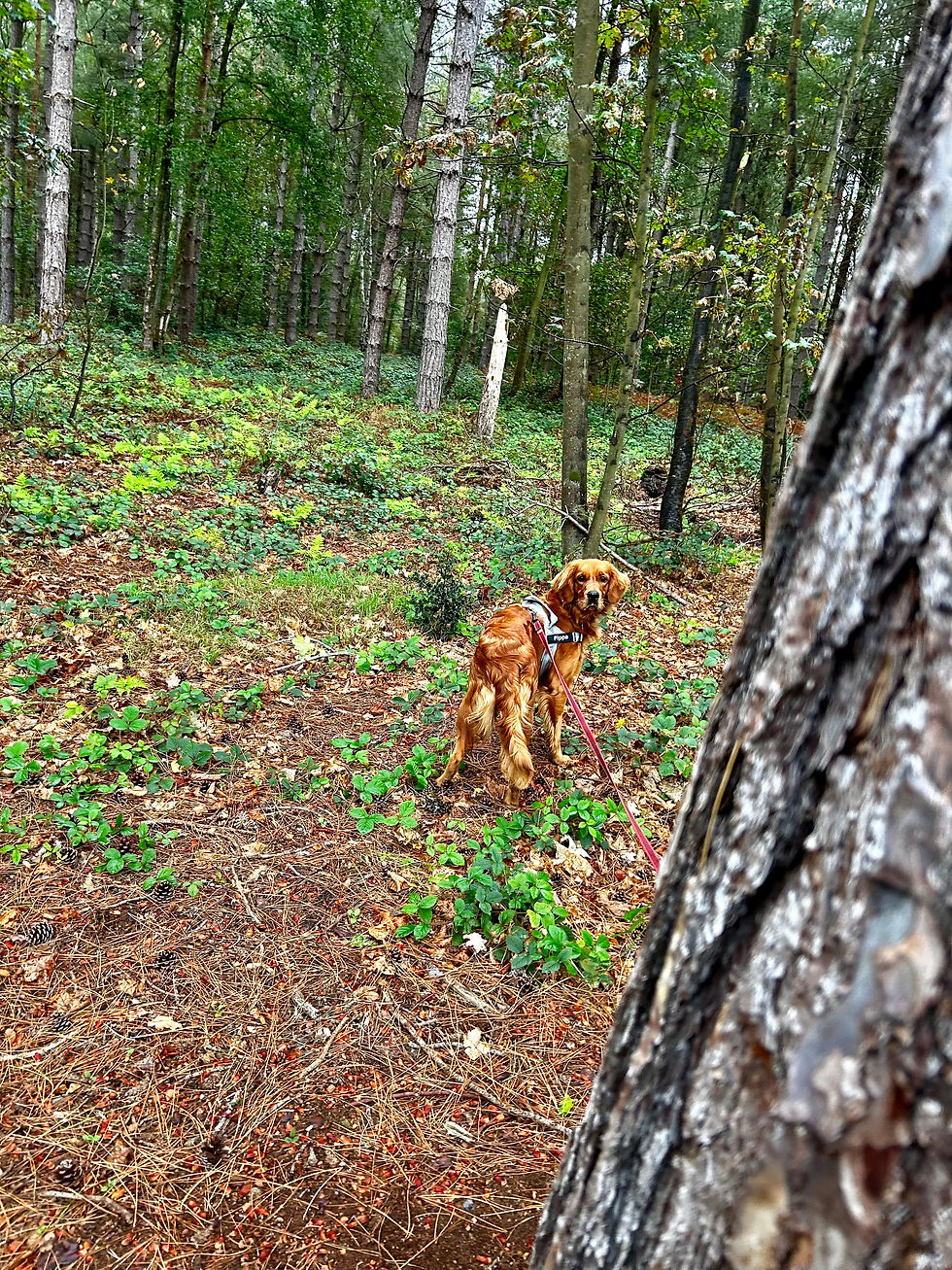
Adolescence has well and truly arrived for Bruno.
At eight months, I’ve noticed a definite increase in his arousal levels and excitement over recent weeks.
I’ve made the decision to put his dummy and rabbit ball aside for now.
Bruno enjoys finding his dummy, but rather than completing a retrieve and bringing it back, he tends to pick it up and run off with his prize. I’ve also noticed that even searching for the dummy can increase his excitement considerably.
Rather than continually rehearsing that behaviour, I’m changing the approach.
We’ll be working with a dumbbell at home, building the retrieve in small stages. Starting with taking the dumbbell, developing a calm hold, progressing to picking it up from the floor and eventually delivering it back to me.
This gives us an opportunity to work on impulse control and the foundations of a retrieve in a much calmer environment, without the added excitement of an outdoor search.
On walks, I’ll be concentrating more on calmer, sniffy walks, allowing plenty of exploration and scatter feeding to encourage him to use his nose.
It’s not about removing everything he enjoys or stopping him from having fun. It’s about recognising when something is becoming too stimulating and adjusting accordingly.
The benefits of slowing things down
Sniffing is a hugely important part of a dog’s everyday life. Dogs experience much of their world through their sense of smell, and opportunities to explore their environment provide valuable enrichment.
A 2025 scientific review, The Value of Sniffing: A Scoping Review of Scent Activities for Canines, examined research into scent-based activities and their potential effects on canine behaviour and physiology.
Although more research is needed to establish the full benefits, it supports the importance of considering scent-based activities as part of canine enrichment.
Instead of constantly directing their activity, try giving them opportunities to:
Explore at their own pace.
Follow interesting scents.
Search for scattered food in suitable areas.
Enjoy quieter walks without constant games.
Have opportunities to rest and recover between activities.
Mental enrichment doesn’t always have to involve complicated games or expensive equipment.
Sometimes the best thing we can offer an adolescent dog is the opportunity to slow down.
Finding the right balance
Every dog is an individual. Breed, age, temperament, health and previous experiences all influence how much activity and stimulation they need.
Exercise is important, play is important and enrichment is important. But so are rest, recovery and learning to settle.
Don’t fall into the trap of thinking that more exercise will automatically produce a calmer dog.
Sometimes doing less, slowing things down and allowing your dog to explore their world can be far more beneficial than another hour of chasing a ball.
Have you noticed your young dog becoming more excitable as they’ve got older? Have you found that slowing things down makes a difference?
Further reading and research
Behavioral and Cortisol-Based Evaluation of Stress in Dogs During Agility Training (2026) – research examining physiological arousal and cortisol during training.
Playing Ball Safely – Cornell University College of Veterinary Medicine – veterinary guidance on repetitive ball chasing, jumping, twisting and injury prevention.
The Value of Sniffing: A Scoping Review of Scent Activities for Canines (2025) – a review of scientific literature on scent-based activities and canine welfare.
Effects of Olfactory and Auditory Enrichment on the Behaviour of Shelter Dogs (2020) – research exploring sensory enrichment and behavioural indicators of arousal.
Hormonal Correlates of Exploratory and Play-Soliciting Behavior in Domestic Dogs (2018) – research investigating relationships between cortisol, exploration and play behaviour.


Comments